Estate Gates in Georgetown, TX

Field notes on estate gates in Georgetown, TX: post footings in limestone soil, frames, hinges, finishes and operators for wide double leaf entries.
What We Cover
- Which Finish Keeps an Estate Gate From Rusting in Georgetown Heat Primer, galvanizing and powder coat choices for steel estate gates facing Central Texas sun, storms and sprinkler overspray.
- Why Wide Estate Gate Leaves Sag and How the Frame and Hinges Prevent It Frame tubing, welded joints, bracing and hinge choice that keep wide estate gate leaves square for years around Georgetown, TX.
- What a Gate Operator Needs From a Wide Entry Near Sun City Texas Swing clearance, slope, power run and safety stops to check before adding a gate operator to a tall double leaf entry.
- Post Hole Depth and Footing Size for Estate Gates in Georgetown Limestone Soil Post hole depth, footing width and drainage for tall estate gate posts set in the limestone and clay around Georgetown, TX.
- Planning an Estate Entry With Columns and a Custom Gate Before Fabrication Opening width, column footings, drawings and lead time for a custom estate entry on a Georgetown, TX lot.
- What Wind Does to Tall Double Leaf Estate Gates on Williamson County Lots How solid panels, picket spacing and bracing change the wind load on wide double leaf gates on exposed lots near Georgetown, TX.
Estate Gates in Georgetown, TX
Estate gate work in Georgetown, TX starts at the ground, not at the gate. The soil is shallow limestone over clay, the lots in Williamson County are wide, and the leaves are tall and heavy, so every decision from post depth to hinge choice carries more load than it would on a standard drive gate.
What the work looks like
A job begins with the opening, the grade and the approach. The crew measures between finished column faces, checks how the drive slopes and marks where a swing leaf will travel. Steel tubing frames are cut, welded and ground, then primed and coated before anything is hung. Hinges, a latch and a drop rod follow, and an operator goes in last if the entry needs one.
Why Georgetown ground is different
Caliche and limestone soil stop an auger early, and the clay above it swells and shrinks with the weather. Footings have to reach the harder layer and shed water away from the post. Spring wind off the Texas Hill Country adds side load to any solid panel, which is why picket spacing and bracing get settled before the steel is cut.
Finish and upkeep
Heat, storm water and sprinkler overspray all work on a steel gate. Bare metal rusts in weeks, so seams are ground smooth, hollow tubing is drained and the coat goes on over clean steel. A yearly look at hinge pins, stops and chips keeps a leaf swinging square for a long time.
Guides
The pages here cover footing depth, wind load, sag, finishes, operators and entry planning for estate gates in Georgetown, TX. Each one is written from the shop and the job site, with the measurements that decide how a gate behaves.
Latest Guides
Building a Double Leaf Estate Gate From Footing to Latch in Georgetown, TX
A double leaf estate gate is built in a fixed order: ground first, posts second, frames third, hardware last. Every step depends on the one before it, and the mistakes that cost the most are the ones made early, in the dirt, where nobody sees them again once the concrete cures. This is the sequence a crew follows on a Georgetown, TX lot, with the measurements that decide whether the gate still swings square in ten years.
What happens before anything is dug?

Before any hole is dug, the crew walks the entry, measures the opening and calls for a utility locate. The walk answers the questions that drawings cannot: how the drive slopes, where runoff travels, how far the leaves will swing and what sits in that arc. Georgetown lots often fall away toward a drainage swale, and a gate hung without noting that grade will drag on one side or leave a gap on the other. The opening is measured at the top and the bottom, because posts and columns are rarely identical in width at both heights. Those numbers set the leaf widths, the hinge positions and the clearance on each side. Nothing is cut until they are written down and checked a second time.
How deep do the posts go in Georgetown ground?
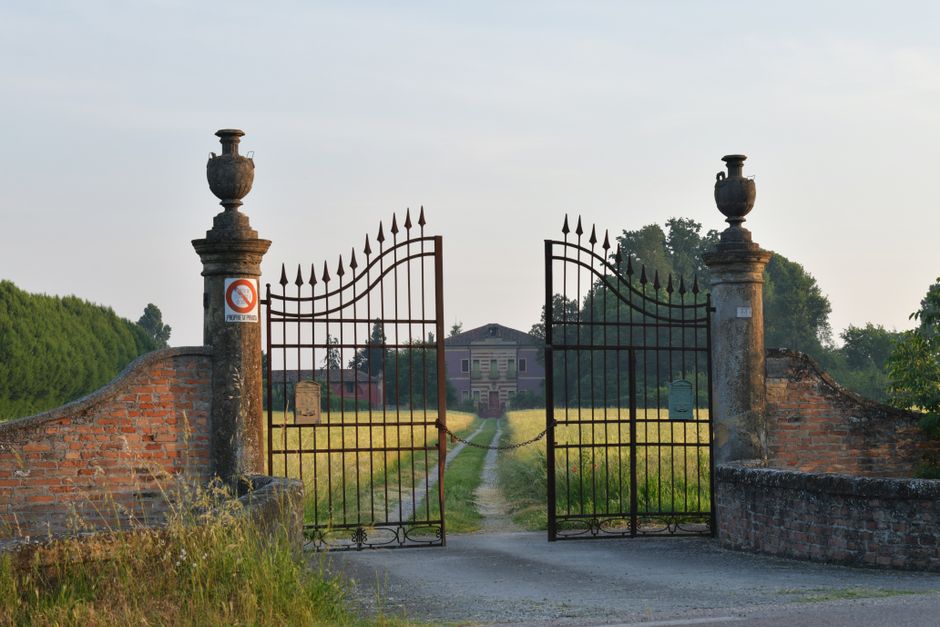
Posts go in at least a third of their height, which means three and a half to four feet for a ten foot post. In Williamson County that depth is rarely easy, because limestone soil and caliche sit close to the surface and stop a standard auger. A rock bit or a hammer drill gets through. The hole is cut wide, at least three times the post width, and belled at the bottom where the soil allows, so the concrete resists rotation as well as settling. A few inches of gravel at the base gives water somewhere to go. The post is set plumb in both directions, braced, and left to cure before it takes any load. A hinge post carries the whole leaf, so it gets more attention than any other part of the job.
Why does the post tubing matter?
Post tubing matters because the post is a lever, and the leaf is pulling on the top of it. A six inch steel tubing post with a heavy wall resists that pull. A four inch post of thin wall bends a little with every swing, and the bend becomes a lean. The wall thickness is chosen for the leaf weight and width, not for appearance. Posts are capped so rain cannot run down the inside, and a small drain hole near the bottom lets condensation out. The same tubing choice shows up again at the frame, where the same logic applies: stiff material at the places that carry load, lighter material where it only fills space.
How is the leaf frame built?
The leaf frame is built flat on a table, square before it is welded and square after. Two inch tubing with a wall of one eighth inch or more suits most single leaves, and heavier stock goes into wide or tall ones. Each corner is welded all the way around, then ground smooth so the finish can cover it evenly. A weld that looks fine but only holds from one side cracks at the toe after a few thousand swings. Pickets are spaced evenly, usually about four inches clear, and welded to the rails with the same care as the corners. A diagonal brace or tension rod goes in last, running from the top hinge corner down to the latch corner, so the weight of the leaf pulls it tight.
What does the finish process involve?
The finish process starts with bare steel and removes everything that is not steel. Mill scale, weld spatter and oil come off by blasting or grinding to bright metal. A zinc rich primer goes on first, then the topcoat, and a baked powder coat holds up best against Central Texas heat and the occasional hail stone. Hollow tubing ends are sealed or drilled for drainage so water cannot sit inside and rust the frame from within. Edges get a second pass, since coating thins at sharp corners and rust starts there. A leaf finished carefully in the shop outlasts one touched up in the field, because the shop can control the surface and the cure.
How are the hinges chosen and set?
Hinges are chosen by leaf weight, and the heavy ones carry the load on a thrust bearing instead of the bare pin. The top hinge is adjustable, so the leaf can be raised or lowered a few millimeters after hanging to close the gap at the latch. Hinge pins are set in line, one directly above the other, because a pair that is out of line binds and wears flat. The leaf is hung on a temporary prop first, checked for level and swing, and only then welded or bolted in place. A leaf that swings freely by hand, with a finger's push, is a leaf hung correctly. If it takes a shove, something is off.
What do the latch and stops do?
The latch holds the leaves together and the stops decide where they end up. A drop rod pins one leaf to a socket in a concrete collar in the ground, and the second leaf closes against it with a latch at center. Stops limit the swing in both directions, so a gust cannot slam a leaf into a column or past its seat. The socket is kept clear of debris, since a rod that cannot seat fully lets the leaf rattle. Each part is simple, and each one fails in a predictable way when it is skipped. Wind on an open lot near Interstate 35 finds every loose piece of hardware sooner or later.
When does an operator go in?
An operator goes in after the gate swings freely by hand, never before. A gate opener exaggerates every flaw in the hanging, from sag to a binding hinge, and will stall or strip a gear trying to move it. Once the leaves move easily, the operator arm is mounted square to the leaf with enough clearance to travel its full arc. Power runs in buried conduit, control wire in its own pipe, and stops are set at the open and closed positions. Safety sensors and a manual release finish the install. A battery backup is worth adding, since storm outages are when a household most wants the gate to open.
What is checked on the last day?
The last day is a measurement day. Each leaf is checked plumb, level and square, the gap at the latch is measured, the stops are tested and the swing is run a dozen times by hand and a dozen more under power. Fasteners are tightened, grease goes on the pins and every weld is looked at again in daylight. Any touch up on the coating happens now, not next season. The owner is shown where the release is, how the drop rod seats and what a healthy swing feels like. A gate that has been checked this way is ready to hang on a Georgetown entry for years with only a yearly look.
Yearly Care for a Steel Estate Gate in Central Texas
A steel estate gate needs about an hour of attention once a year, and most of that hour is looking. The failures that cost real money, a sagging leaf, a seized hinge, rust through a bottom rail, all announce themselves months earlier to anyone who checks. This is the walk a crew does on an estate entry in Georgetown, TX, in the order that finds problems soonest.
When is the best time to inspect a gate?

The best time is late winter, before spring storms and before the heat. Wet clay has settled by then, the ground has been through its coldest weeks and any damage from winter wind is visible. A second quick look after the first hard summer week catches heat related binding. Between those two visits a gate needs nothing beyond noticing. If it sounds different, swings differently or closes with a new gap, that is the cue to look sooner. A gate that was quiet last year and rattles this year is telling the owner exactly where to start.
What should be checked on the posts?
The posts come first, because everything else hangs from them. A level held against each post, front and side, shows whether it has leaned. A quarter inch of lean at the bottom becomes more than an inch at the top of a seven foot leaf. Limestone soil and clay around Georgetown move with moisture, so a post that was plumb at install can shift after a dry summer or a wet spring. Cracks in the concrete collar at ground level, or a gap opening between the collar and the steel, point to movement. Caps should be sealed and the base should drain freely instead of holding a puddle.
How are hinges checked and greased?
Hinges are checked by lifting the leaf slightly and feeling for play. A pin that moves up and down or a hinge that clicks means the washer stack or the bearing is worn. The leaf is swung slowly through its arc, and any grinding or dragging is noted. Pins get fresh grease through the fitting or at the joint, and the excess is wiped off so it does not collect grit. An adjustable top hinge can be turned to close a gap at the latch. Worn strap hinges are replaced, not adjusted, since a hinge worn flat will only get worse and drags the whole frame with it.
Where do welds fail first?
Welds fail first at the corners of the frame and at the hinge plates, where the load is highest. A hairline crack at the toe of a weld, or a thin line of rust weeping from a joint, means the metal is moving under load. Each corner is looked at closely, with a light if the sun is behind the gate. Pickets that rattle when tapped point to a loosened joint. A cracked weld on a frame is a shop repair, ground out and rewelded, and not something to cover with paint. Catching it early saves the leaf, because a small crack repaired in a morning is far cheaper than a frame rebuilt after it racks.
How is the finish maintained?
The finish is maintained by finding chips before rust does. Any spot that has gone through the coating to bare metal is cleaned, primed with zinc rich primer and sealed with a matching topcoat. The bottom rail and the lower third of each leaf are checked most closely, since sprinkler spray and splashed rain hit them first. Mineral crust from irrigation water is washed off with plain water and a soft brush. Heads that spray the gate are re-aimed at the lawn. Drain holes in hollow tubing are poked clear of debris, because a blocked drain turns the inside of a rail into a trough that rusts it from within.
What about the drop rod, stops and latch?
The drop rod, stops and latch are the hardware that wind tests first, so they are tested by hand. The rod is lifted and dropped to confirm it seats fully in its socket, and the socket is cleared of dirt and gravel. Stops are checked for cracks at the weld and for bending. The latch should catch without a lift or a slam, and if it needs either one the leaf has sagged or the post has leaned. Loose bolts are tightened and any worn pieces replaced. Open leaves are never left to swing in a gust on a windy day, since a leaf thrown against its stop takes the hit on the hinge.
How is an operator kept healthy?
An operator is kept healthy by keeping the gate easy to move. The simplest test is to disconnect the arm and swing the leaf by hand, and if it takes effort the gate needs work before the motor does. Photo eyes are wiped clean and tested with an object in the beam. The manual release is tried, since a release that has never been used is often seized. Battery backups are checked before storm season, and conduit entries are looked at for water. A stalled operator is usually a gate problem in disguise, and fixing the leaf is cheaper and kinder to the motor than replacing the gearbox.
What does a quick log of each inspection look like?
A short written log turns a yearly walk into a trend line. Note the date, the weather, and three measurements: the gap between the leaf and the latch post at the top and bottom, the height of the bottom rail above the pavement at the free end, and how far the leaf swings on its own when released from a quarter open. A leaf that swings farther on its own than last year is leaning, and a bottom rail that sits lower at the free end is sagging. Neither shows up as a clear failure in a single visit, but both are plain on paper after two or three years.
Add a line for anything that was touched. If a hinge was greased, a bolt was snugged or a scratch was dabbed with primer, write it down with the spot. Georgetown soil moves between wet springs and dry summers, so a post that held steady for years can start to lean after a season of heavy rain followed by drought. Photographs taken from the same spot each year, with a tape measure hanging from the top rail for scale, make the comparison easy even for someone who was not there last time. That log is also the first thing a fabricator will ask for when a repair is quoted.
When is it time to call a fabricator?
It is time to call a fabricator when a problem is structural, not cosmetic. A leaf that sags more than a finger's width at the latch, a post that has leaned visibly, a cracked weld, rust that has gone through steel instead of sitting on it and an operator that stalls on a hand-free leaf all need shop work. Surface chips, dry hinges and a dirty photo eye are owner jobs. Written notes from each yearly walk help, because a change from one year to the next shows up in the notes before it shows up in the gate. A gate that gets this one hour each year stays square far longer than one that gets none.

Nearby Service Areas
We also cover iron gates carlsbad, ca pros in Carlsbad.